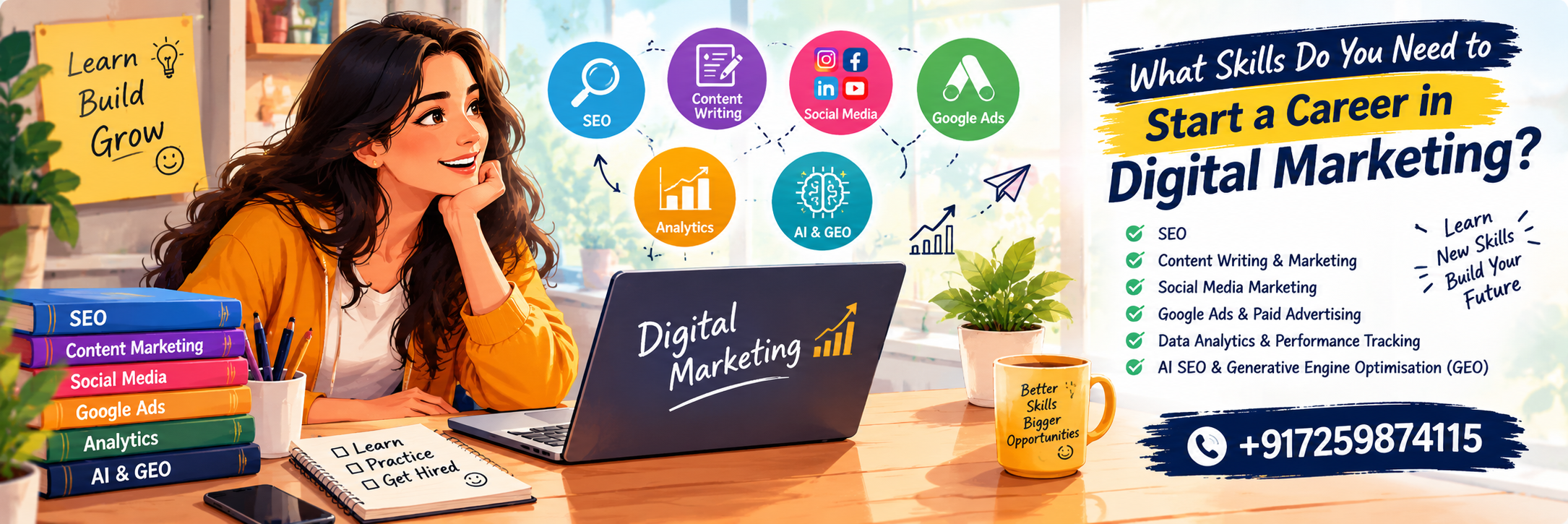
What Skills Do You Need to Start a Career in Digital Marketing?
Digital marketing skills, beginner career guide, SEO, content marketing, social media, Google Ads, AI SEO, GEO, digital marketing training and career opportunities.
Digital marketing has become an important part of how businesses promote their products and services online. From small businesses to large companies, organisations use digital platforms to reach customers, build brand awareness, and generate leads. As a result, digital marketing offers career opportunities for students, graduates, job seekers, and professionals who want to develop new skills.
If you are planning to start a career in digital marketing, learning the right skills is an important first step. You do not need to master every digital marketing technique at once. Instead, focus on the essential skills, practise them regularly, and gain practical experience through projects.
In this guide, we will explore the key digital marketing skills for beginners, including traditional marketing techniques, artificial intelligence (AI), and Generative Engine Optimisation (GEO).
1. Search Engine Optimisation (SEO)
Search Engine Optimisation (SEO) helps websites improve their visibility in search engine results. Businesses use SEO to attract relevant visitors who are searching for their products, services, or information.
To develop SEO skills, beginners should understand:
- Keyword research and search intent
- On-page SEO and content optimisation
- Title tags and meta descriptions
- Internal linking and website structure
- Basic technical SEO
- Website performance and search analytics
Practising SEO on a website or blog can help you understand how search engines discover and organise content. It also gives you an opportunity to learn how to improve pages based on user needs and search performance.
As search technology evolves, SEO professionals also need to understand how AI-powered search experiences present information. Strong SEO fundamentals remain a useful starting point for learning these developments.
2. Content Writing and Content Marketing
Content writing and content marketing play an important role in digital marketing. Businesses use blog articles, website pages, social media posts, email campaigns, and other content formats to communicate with their audiences.
A digital marketer should know how to create useful, clear, original, and engaging content. Important content-writing skills include understanding the target audience, organising information, writing effective headlines, and using keywords naturally.
You should also learn how to match content with search intent. For example, an informational blog should answer a reader's question, while a service page should explain a business's offering.
Good content should be written for people first. Use accurate information, clear explanations, appropriate examples, and reliable sources where necessary. These practices can also help make content easier for search systems and AI-powered tools to understand.
Regular writing practice can improve your grammar, clarity, research skills, and ability to communicate ideas effectively.
3. Social Media Marketing
Social media marketing allows businesses to connect with customers, share updates, promote products, and build communities. It involves planning content, publishing posts, interacting with audiences, and measuring performance.
Beginners should learn how to:
- Create a social media content calendar
- Understand different platform audiences
- Write engaging captions
- Plan posts and campaigns
- Monitor comments and engagement
- Review reach, clicks, and engagement metrics
Practical experience is especially valuable in this area. Try creating a sample content calendar for a business and compare the performance of different types of posts.
Understanding how audiences respond to different formats can help marketers develop better content strategies and communicate more effectively with potential customers.
4. Google Ads and Paid Advertising
Paid advertising helps businesses reach specific audiences through search engines, social media platforms, and other online channels. Google Ads is one of the tools used to promote products and services to people searching for relevant terms.
Important beginner skills include keyword selection, audience targeting, ad copywriting, budget planning, conversion tracking, and campaign performance analysis.
You should also understand the difference between paid advertising and organic marketing. SEO aims to improve unpaid search visibility, while paid campaigns use advertising budgets to reach potential customers.
Learning the fundamentals of campaign structure and measurement can help you understand how businesses evaluate advertising results and manage their marketing budgets.
5. Data Analytics and Performance Tracking
Digital marketing involves more than publishing content or running advertisements. Marketers also need to understand whether their activities are producing useful results.
Analytics skills help you measure website traffic, user engagement, campaign performance, and conversions. Tools such as Google Analytics and Google Search Console can help marketers examine different aspects of website and search performance.
Start by learning how to interpret basic metrics, including:
- Website sessions and users
- Search impressions and clicks
- Click-through rate (CTR)
- Engagement and conversion data
- Paid campaign results
The aim is not simply to collect numbers. You should learn to identify patterns, understand what may be affecting performance, and use the findings to improve future campaigns.
For example, if a blog receives impressions but few clicks, reviewing the page title, meta description, search intent, and ranking position may help identify opportunities for improvement.
6. Basic Graphic Design and Video Content
Graphic design and video content are widely used across websites, advertisements, and social media platforms. Digital marketers who understand basic design principles can communicate messages more effectively and collaborate better with designers.
Learn the fundamentals of colour combinations, typography, layout, image selection, and visual consistency. You can also practise creating social media graphics, promotional banners, and short videos using beginner-friendly tools.
You do not necessarily need to become a professional designer. However, knowing how to create clear and suitable visual content can be useful in many digital marketing roles.
7. Communication and Problem-Solving
Communication skills are essential for digital marketers. You may need to explain campaign results, write content, work with clients, coordinate with colleagues, or present recommendations.
Strong communication involves writing clearly, listening carefully, understanding business objectives, and presenting information in a way that others can understand.
Problem-solving skills are equally important. If website traffic declines or an advertising campaign performs poorly, you should be able to investigate possible causes and suggest improvements based on evidence rather than assumptions.
These skills can help you work more effectively with clients, managers, and team members.
8. Website Management and WordPress
A basic understanding of websites is valuable for digital marketing beginners. Many marketing activities involve updating website content, publishing blogs, adding images, improving page structure, and checking that pages work properly.
Learning WordPress can help you understand how content management systems operate. You can practise creating pages, publishing articles, adding headings, inserting internal links, and writing page titles and meta descriptions.
Understanding website structure also makes it easier to collaborate with SEO specialists, developers, and content teams.
A well-organised website with clear navigation and useful content can provide a better experience for visitors and help search engines discover relevant pages.
9. AI SEO and AI-Assisted Digital Marketing
Artificial intelligence (AI) is changing how digital marketers research, plan, create, and evaluate marketing campaigns. AI-powered tools can support keyword research, content planning, audience analysis, competitor research, and performance reporting.
AI SEO refers to using AI tools to support SEO tasks and improve the efficiency of research and optimisation. For example, marketers can use AI to organise keyword ideas, identify content gaps, create article outlines, and analyse questions that potential customers may ask.
Beginners should learn how to:
- Use AI tools for keyword research and content planning
- Identify search intent and related user questions
- Develop content outlines and topic clusters
- Review website content for clarity and completeness
- Analyse information and identify optimisation opportunities
- Fact-check AI-generated information before publishing
However, AI-generated content should never be accepted without review. It may contain incorrect information, repetitive wording, or unsupported claims. Human judgement, accuracy, originality, and usefulness remain essential.
The goal is to use AI as a support tool while ensuring that the final content meets the needs of the intended audience.
10. Generative Engine Optimisation (GEO)
Generative Engine Optimisation (GEO) is an emerging area of digital marketing that focuses on helping useful and trustworthy content become easier for AI-powered search and answer systems to understand and potentially reference in generated responses.
Traditional search engines commonly present a list of relevant webpages. AI-powered search experiences may also generate summaries and answers using information from multiple sources. GEO explores how content can be prepared for these experiences.
Beginners interested in GEO should understand the importance of:
- Creating helpful, accurate, and original content
- Answering common user questions clearly
- Using descriptive headings and logical content structure
- Supporting factual claims with reliable sources
- Maintaining clear and consistent information about a business
- Improving website accessibility and crawlability
- Building relevant internal links between website pages
- Updating outdated or inaccurate information
For example, an article that clearly explains a topic, answers related questions, and supports important claims with reliable sources may be easier for people and automated systems to interpret.
It is important to understand that GEO cannot guarantee that a website will appear in AI-generated answers. There is no single formatting trick or keyword that ensures inclusion. The practical approach is to publish useful content, maintain a technically accessible website, and continue following sound SEO principles.
Learning both traditional SEO and GEO can help beginners understand how online discovery is evolving.
11. Continuous Learning and Adapting to New Tools
Digital marketing platforms, consumer behaviour, and search technology continue to evolve. Marketers need to keep learning to remain effective in their roles.
Follow reliable industry resources, explore new tools, review platform updates, and practise through small projects. You can also learn by analysing successful campaigns and reviewing the results of your own work.
Rather than trying every new tool, focus on technologies that solve a real marketing problem. Combine practical experience with critical thinking, creativity, and data-driven decision-making.
How Can Beginners Learn Digital Marketing Skills?
If you are new to digital marketing, follow a structured learning approach rather than trying to learn every topic at once.
Step 1: Understand the fundamentals. Learn how SEO, content marketing, social media, paid advertising, and analytics work together.
Step 2: Explore AI SEO and GEO. Learn how AI tools can support research and optimisation, and understand the principles of creating helpful content for AI-powered search experiences.
Step 3: Choose a practical project. Create a sample website, blog, or social media campaign where you can apply your knowledge.
Step 4: Practise with relevant tools. Explore website platforms, keyword research tools, analytics dashboards, and advertising interfaces.
Step 5: Measure your results. Review the available data and identify what could be improved.
Step 6: Build a portfolio. Keep examples of your work, such as blog posts, keyword research, content calendars, SEO audits, and sample campaigns.
Step 7: Consider structured training. If you need guidance and hands-on practice, explore an online digital marketing course to review the training topics and learning approach available.
Career Opportunities in Digital Marketing
Once you develop foundational skills and gain practical experience, you can explore different digital marketing career opportunities. The opportunities available will depend on your abilities, portfolio, experience, and the requirements of individual employers.
Some possible career paths include:
- SEO Executive
- Digital Marketing Executive
- Social Media Executive
- Content Writer
- PPC or Google Ads Executive
- Email Marketing Executive
- Digital Marketing Analyst
- AI SEO Specialist
- GEO or AI Search Optimisation Specialist
Roles involving AI search optimisation are evolving, and job titles and responsibilities can vary between employers. Beginners should first develop strong digital marketing fundamentals before specialising in a newer area.
You can begin by focusing on one or two areas that interest you, then expand your knowledge as you gain experience.
Frequently Asked Questions
What skills do I need to start a career in digital marketing?
Useful foundational skills include SEO, content writing, social media marketing, paid advertising, analytics, website management, communication, and problem-solving. Understanding AI tools and GEO can also help you explore emerging developments in search.
Can I learn digital marketing without experience?
Yes. Beginners can start by learning the fundamentals, practising with sample projects, and building a portfolio that demonstrates their skills.
What is the difference between SEO and GEO?
SEO focuses on improving a website's visibility in traditional search results and other search experiences. GEO focuses on preparing useful content to be understood and potentially referenced in AI-generated answers. The two areas overlap, and good content and technical foundations can support both.
How is AI used in digital marketing?
AI tools can assist with keyword research, brainstorming, content planning, audience analysis, campaign reporting, and other tasks. Marketers must still check accuracy, protect confidential information, and use human judgement before acting on AI-generated recommendations.
Do I need coding skills to become a digital marketer?
Advanced coding is not required for many entry-level roles. However, basic website knowledge and an understanding of HTML concepts can be helpful, particularly in SEO and website management.
How can I gain practical experience?
You can practise by creating a blog, managing a sample social media account, conducting keyword research, or preparing a mock advertising campaign. Documenting your work helps demonstrate what you have learned.
Is digital marketing a good career option for beginners?
Digital marketing may suit people who enjoy communication, creativity, research, and data analysis. Career opportunities and progression depend on your skills, practical experience, and the needs of employers.
Conclusion
Starting a career in digital marketing involves developing a combination of technical knowledge, creativity, communication, and analytical thinking. SEO, content writing, social media marketing, paid advertising, website management, and analytics provide a useful foundation.
As search technology evolves, AI SEO and Generative Engine Optimisation (GEO) are additional areas worth exploring. Understanding AI-assisted research, creating trustworthy content, and adapting to new search experiences can help beginners prepare for changes in the digital marketing industry.
You do not have to learn everything immediately. Start with the fundamentals, practise through real or sample projects, measure your results, and keep improving your skills over time.
With consistent learning and practical experience, you can build a foundation for exploring digital marketing career opportunities. If you want to explore structured learning, visit M8 Academy to learn more about its digital marketing training.