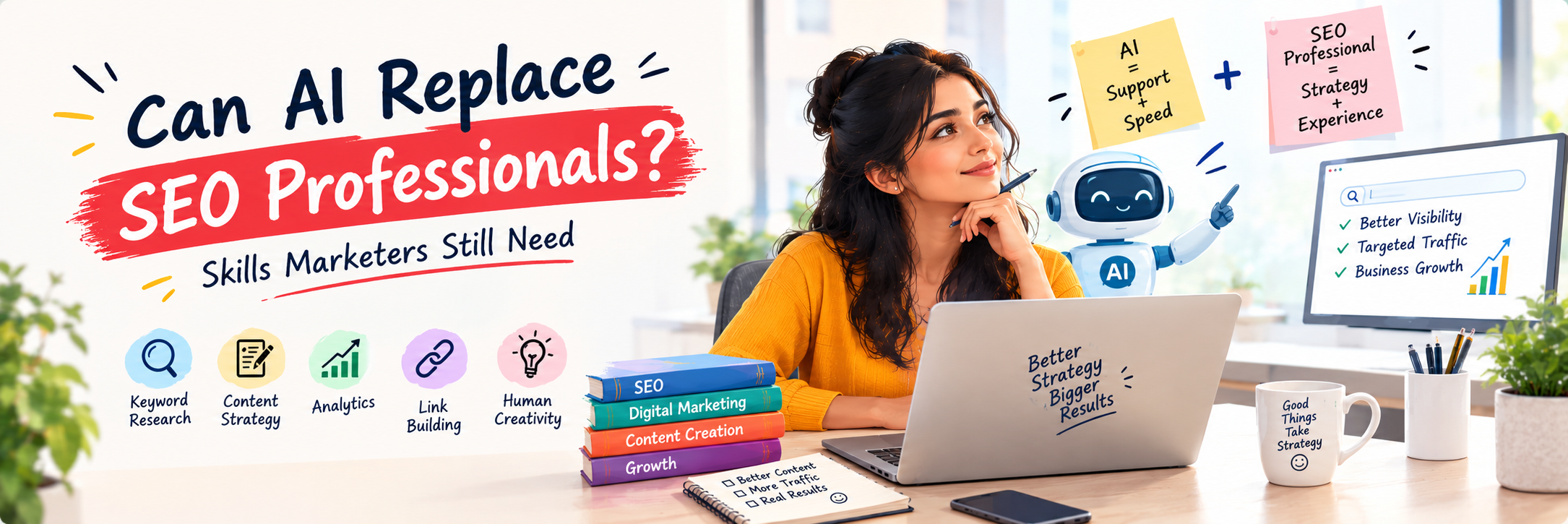
Can AI Replace SEO Professionals? Skills Marketers Still Need
Explore how AI is transforming SEO, the skills marketers still need, and how beginners can build a successful career in digital marketing.
Artificial intelligence is changing the way people work in digital marketing. Today, marketers can use AI tools to find keywords, generate blog ideas, analyse website performance, and prepare content outlines in less time than before. Because of these changes, many people are asking an important question: Can AI replace SEO professionals?
The simple answer is no, not completely. AI can handle many routine SEO tasks, but it still needs human guidance to produce meaningful results. An SEO professional understands what a business wants to achieve, what its audience is searching for, and which improvements can help a website perform better.
For example, an AI tool can write a blog about a digital marketing course in a few minutes. However, someone still needs to check whether the information is correct, whether the article answers students' questions, and whether it provides a useful reason for them to explore the course.
This is where SEO professionals continue to play an important role. Instead of replacing their work entirely, AI can help them save time, reduce repetitive tasks, and focus on decisions that require experience and understanding.
What Is AI in SEO?
AI in SEO means using artificial intelligence to support the work involved in improving a website's visibility on search engines.
SEO professionals often spend time researching keywords, planning content, checking website issues, and analysing reports. AI tools can make some of these tasks easier by organising information and suggesting possible solutions.
For example, when planning a blog about SEO careers, a marketer can use AI to explore related topics such as technical SEO, keyword research, and the skills needed for an SEO job.
These suggestions can help the marketer get started. However, the next step is to check whether people are searching for those topics and whether the website already has similar content.
AI can provide ideas, but the SEO professional decides which ideas are worth using.
Can AI Replace SEO Professionals?
AI can perform certain SEO tasks, but running a successful SEO campaign involves much more than completing individual activities.
Consider a digital marketing institute that wants more students to visit its website and enquire about its courses.
An AI tool can suggest keywords, prepare a blog outline, and help write an article. However, an SEO professional must decide which keywords are relevant, what information students need, and how the article should connect to the institute's course pages.
The work does not end after publishing the blog.
Suppose the article starts receiving visitors from Google, but very few people enquire about the course. The SEO professional needs to understand why this is happening. Perhaps the article attracts people who are only looking for general information, or perhaps readers cannot easily find details about the course.
In this situation, publishing more articles may not be the right solution. Improving the existing content, adding relevant internal links, or making the course information easier to find could be more useful.
AI can help identify possible improvements, but the SEO professional must review the available information and decide what to do next.
This is why AI is better viewed as a tool that supports SEO work rather than a complete replacement for SEO professionals.
When marketers use AI correctly, they can spend less time on repetitive activities and more time improving website performance, understanding customers, and planning better strategies.
How AI Helps SEO Professionals in Their Daily Work
AI can make several everyday SEO tasks easier. The biggest benefit is the time it can save when used alongside proper research and human review.
1. Finding Keywords and Blog Ideas
Keyword research is an important part of SEO because it helps marketers understand what people search for online.
AI tools can suggest related keywords, common questions, and possible blog topics. For example, a website offering digital marketing training could explore topics related to SEO careers, beginner marketing skills, and the use of AI in digital marketing.
These ideas help marketers discover topics they may not have considered.
However, not every suggested keyword is worth targeting. The SEO professional must check search demand, review the existing search results, and understand what users expect to find.
They should also check whether the website already covers the topic. Creating another article on the same subject may not be necessary if an existing page can be improved.
By combining AI suggestions with keyword research tools, marketers can plan content more effectively and avoid spending time on topics that do not suit their audience.
2. Writing and Improving Content
Writing useful content takes time, especially when an article requires research and clear explanations.
AI can help writers prepare an outline, organise headings, correct grammar, and simplify difficult concepts. It can also suggest examples that help readers understand unfamiliar topics.
For example, someone writing about technical SEO may need to explain crawling and indexing to beginners. AI can help prepare a simple explanation that the writer can review and improve.
However, generated content is not always accurate or interesting. Sometimes it repeats the same point, includes unnecessary information, or fails to answer the reader's main question.
The writer must review the draft, check important facts, and add examples that make sense for the intended audience.
The goal should not be to publish as many articles as possible. It should be to publish content that genuinely helps readers.
3. Understanding Technical SEO Issues
Technical SEO helps search engines discover and understand website pages.
When a page is not indexed or a website has broken links, an AI tool can help explain possible reasons and suggest areas to investigate.
For example, if an important course page does not appear in Google search results, AI may suggest checking the page's indexing status, internal links, or technical settings.
These suggestions can help an SEO professional understand where to begin.
However, the actual problem must be confirmed before making changes. A page may have a technical issue, or Google may simply not have selected it for indexing.
Changing website settings without understanding the cause can create further problems.
SEO professionals need enough technical knowledge to investigate the issue, verify the findings, and work with developers when necessary. AI can support this process, but it cannot replace the need to understand the website.
4. Analysing SEO Performance
SEO professionals regularly check website performance using tools such as Google Search Console and Google Analytics.
AI can help summarise reports and highlight changes that need attention.
For example, imagine that a blog received 500 clicks from Google last month but only 300 clicks this month.
Instead of immediately rewriting the article, the SEO professional should compare the reporting periods and check impressions, click-through rate, search positions, and the queries bringing visitors to the page.
They may discover that the page has lost visibility for important keywords or that people are seeing the page but clicking less often.
Each situation requires a different response.
AI can help organise the data and suggest possible explanations, but the marketer must investigate the actual results before deciding what changes are needed.
This helps SEO professionals spend less time preparing reports and more time understanding how to improve performance.
What Skills Do SEO Professionals Still Need?
AI can make SEO work easier, but professionals still need practical skills to use these tools effectively.
1. Understanding What People Search For
Not everyone who searches on Google is looking for the same thing.
Someone searching for "What is SEO?" probably wants to understand the basics. Someone searching for "SEO course for beginners" may be looking for training options.
An SEO professional needs to understand this difference and create the right type of content for each search.
For example, a blog can explain SEO concepts, while a course page can provide information about the programme, what students will learn, and how the course is structured.
AI can suggest content ideas, but the professional must make sure the final page answers the question behind the search.
Understanding search intent also helps avoid creating multiple pages that serve almost the same purpose.
2. Creating Useful and Reliable Content
Anyone can use an AI tool to generate an article, but creating content that people find useful requires more effort.
A good article should answer the main question, explain important details, and give readers information they can understand and apply.
For example, an article about keyword research should do more than say that keywords are important. It should explain how to find relevant search terms, check the search results, and choose an appropriate page for the topic.
An SEO professional should also check facts, remove repeated explanations, and make sure the content matches the audience's needs.
These improvements help turn a basic AI-generated draft into a useful resource.
3. Analysing Data and Finding Problems
SEO professionals must understand what website data actually means.
A page may receive more impressions but fewer clicks. Another page may attract many visitors without generating enquiries.
These results require investigation rather than assumptions.
For example, if a digital marketing institute receives traffic from people searching for free SEO tools, those visitors may not necessarily be interested in enrolling in a paid course.
The SEO professional needs to understand which searches bring visitors to the website and whether those visitors match the business's target audience.
AI can help organise the information, but the professional must interpret the results and decide what action makes sense.
4. Understanding Technical SEO
Basic technical knowledge helps SEO professionals identify problems that affect website visibility.
Important areas include indexing, crawling, redirects, canonical tags, internal links, and structured data.
Suppose an important page is missing from Google. An SEO professional should investigate its indexing status, check whether search engines can access it, and review the relevant technical settings.
Simply asking AI for a solution and applying the first suggestion may not solve the problem.
Professionals who understand technical SEO can evaluate AI recommendations more carefully and explain the required changes to developers.
5. Planning an SEO Strategy
SEO is not just about finding keywords and publishing blogs. The work should support the goals of the business.
A phone repair business may want more repair enquiries, while a training institute may want more course registrations.
The right SEO priorities depend on these goals.
For example, if a website already has several articles about SEO basics, writing another similar article may not be the best use of time. Updating an existing article, improving its internal links, or fixing a technical issue may be more valuable.
AI can suggest different options, but an SEO professional must decide which task deserves attention first.
This ability to plan and prioritise work is one of the reasons human expertise remains important.
How Can SEO Professionals Use AI More Effectively?
The best way to use AI is to include it in the SEO process without depending on it for every decision.
A simple workflow can help professionals save time while maintaining content quality.
Step 1: Research the topic.
Understand the audience and identify the questions the content should answer. Use AI to explore ideas, then verify them through keyword research and search-result analysis.
Step 2: Choose the right page.
Decide whether the topic belongs on a new blog post or an existing service, product, or course page.
Step 3: Prepare the content outline.
Ask AI to suggest headings and supporting questions. Keep the sections that are relevant and remove unnecessary repetition.
Step 4: Review the content.
Check the facts, improve the explanations, and add useful examples. Make sure the final article answers the reader's question.
Step 5: Optimise the page.
Review the title, meta description, headings, URL, and internal links. Check technical issues before making changes to the website.
Step 6: Monitor the results.
Use website performance data to understand whether the changes are helping. If the results are not as expected, investigate the reasons and improve the approach.
This process allows AI to handle parts of the preparation while the SEO professional remains responsible for the final decisions.
How Beginners Can Prepare for an SEO Career in the AI Era
For beginners, AI should be a reason to learn SEO more effectively, not a reason to avoid the field.
Start by understanding how search engines work, how people search for information, and how website content can be improved.
Some important skills to learn include keyword research, on-page SEO, technical SEO basics, content writing, internal linking, and Google Search Console.
It is also useful to learn how AI tools can support research, content planning, and reporting.
A structured SEO course for beginners can help learners understand these topics step by step.
Practical experience is equally important. For example, beginners can select a webpage, identify its target keywords, review the existing content, and prepare an improvement plan.
After making appropriate changes, they can monitor the page's performance and study the results.
This experience helps learners understand not only how to make SEO changes but also why those changes matter.
Students who want to explore other areas of digital marketing can also visit M8 Academy to learn about the relationship between SEO, content marketing, social media, online advertising, and analytics.
By combining practical experience with responsible AI use, beginners can develop skills that are useful in a changing digital marketing industry.
Frequently Asked Questions
1. Will AI replace SEO professionals in the future?
AI may automate more SEO tasks in the future, but professionals will still need to understand search intent, investigate technical issues, evaluate content, and make strategic decisions. The way SEO work is performed may change as AI develops.
2. Is SEO still worth learning?
Yes. SEO helps businesses improve their visibility in search engines and attract relevant audiences. Learning SEO alongside AI tools can help beginners understand both the fundamentals and the newer technologies used in digital marketing.
3. How does AI help SEO professionals?
AI can help with keyword ideas, content outlines, report summaries, and technical SEO investigations. These tasks can take less time with AI assistance, allowing professionals to focus more on research, strategy, and problem-solving.
4. Can beginners use AI to learn SEO?
Yes. Beginners can use AI to understand SEO concepts, explore keyword ideas, and practise preparing content outlines. They should also work with real webpages and performance data to develop practical skills.
5. What is the most important skill for SEO professionals using AI?
There is no single skill that guarantees success. However, critical thinking is especially valuable because professionals must evaluate AI suggestions, verify information, and decide which actions will benefit the website.
Conclusion
AI is changing the way SEO professionals work, but it does not remove the need for SEO knowledge and experience.
It can help marketers research keywords, prepare content, understand reports, and investigate website issues more efficiently. However, choosing the right strategy, checking the accuracy of information, and understanding business needs still require careful judgement.
For businesses, this means AI can support their SEO teams and improve productivity. For beginners, it means learning SEO fundamentals and understanding how to use AI responsibly are both important.