What Should You Check Before Investing in Digital Marketing Services?
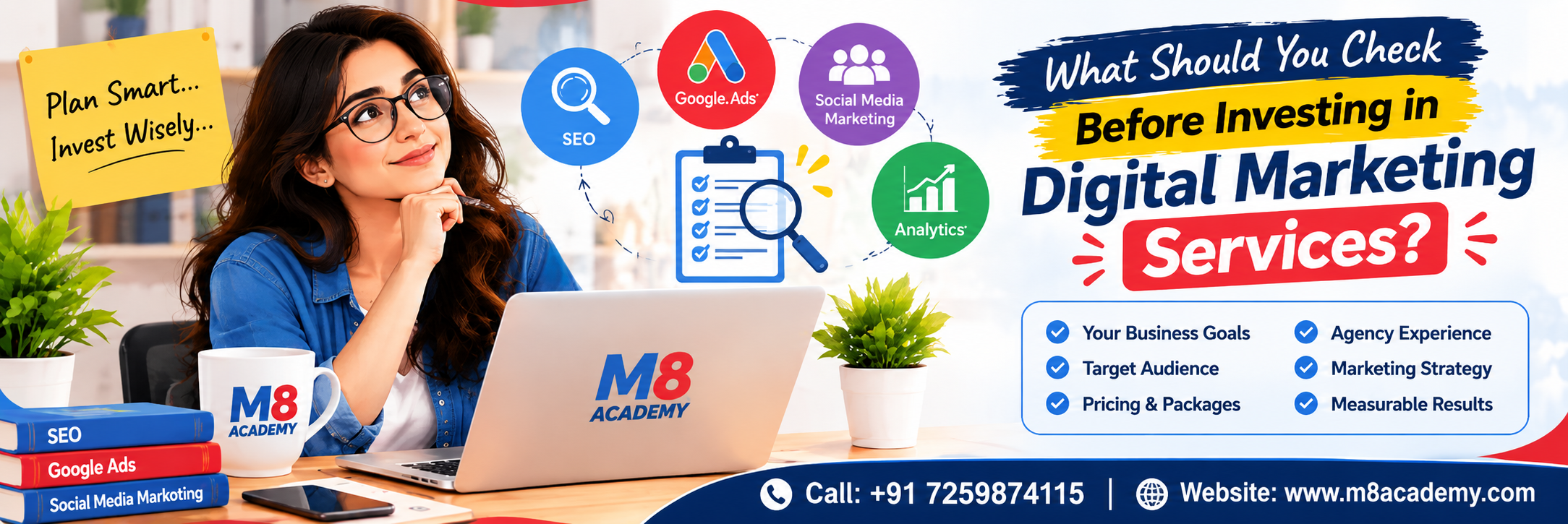
A professional digital marketing banner highlighting the key factors to consider before investing in digital marketing services, including SEO, Google Ads, social media marketing, business goals, target audience, pricing, customised strategies, and measurable results. Created for business owners looking to make informed marketing decisions with M8 Academy.
Digital marketing can help your business reach more customers, generate enquiries, and grow online—but only if you invest in the right services. Before hiring an agency or buying a marketing package, it is important to understand your goals, target audience, budget, and expected results.
Many businesses spend money on SEO, Google Ads, social media marketing, or website development without knowing which services they actually need. As a result, they may get website traffic or social media followers but still struggle to generate quality leads or sales.
The right digital marketing strategy should match your business goals, audience, industry, and budget. Before choosing a service provider, here are 10 important things every business owner should check.
1. Define Clear Business Goals First
Before contacting a digital marketing agency, understand exactly what you want to achieve.
Every business has different marketing needs. A new business may want to build brand awareness, while an established company may want more website enquiries, phone calls, online sales, or student registrations.
For example:
- A local service business may want more customer enquiries and phone calls.
- An online store may want to increase product sales.
- A coaching institute may want more student admissions.
- A real estate company may want qualified property enquiries.
- A restaurant may want more online orders and local customers.
When your goals are clear, it becomes easier to choose the right marketing services. Avoid investing in every available service simply because it is included in a package. Choose services that directly support your business objectives.
2. Choose Services That Match Your Goals
Not every business needs the same digital marketing approach. Some businesses benefit more from SEO, while others may need paid advertising, social media marketing, or website improvements.
Here are some common digital marketing services:
- Search Engine Optimization (SEO): Helps improve your website’s visibility in search engines so potential customers can find your products or services.
- Google Ads: Paid search advertising that helps your business appear for relevant searches and generate faster leads.
- Social Media Marketing: Helps businesses connect with audiences, share updates, build trust, and increase brand awareness.
- Content Marketing: Blogs, guides, FAQs, and useful website content that answer customer questions and build authority.
- Website Design and Development: A website should clearly explain your services and make it easy for visitors to contact you or take action.
- Local SEO and Google Business Profile: Useful for businesses that serve customers in a specific city, area, or locality.
Before selecting a package, ask the agency which services are relevant to your industry and why they are being recommended.
If you want to understand how these marketing channels work before investing, exploring digital marketing training can help you make more informed decisions.
3. Understand Your Target Audience
A marketing campaign may reach thousands of people, but that does not mean those people are interested in your products or services.
Before investing, you should know who your ideal customers are, where they are located, what problems they are trying to solve, and which platforms they use regularly.
For example, if you run a digital marketing training institute, your target audience may include students, graduates, working professionals, freelancers, and business owners who want to improve their marketing knowledge.
A local service provider may need to target customers within specific cities or neighbourhoods. An e-commerce business may need to target people based on interests, shopping behaviour, and product preferences.
Ask whether the marketing provider understands:
- Your ideal customer profile
- Customer location and interests
- Customer problems and needs
- Platforms your audience uses
- Factors that influence their buying decisions
A good campaign focuses on reaching the right people, not simply increasing website traffic or social media followers.
4. Compare Pricing, Deliverables, and Hidden Costs
Digital marketing service costs can vary based on the services offered, competition, business requirements, and campaign complexity. One provider may offer a low monthly package, while another may charge more for a customised strategy.
However, the cheapest option is not always the best choice.
Before investing, ask for a clear breakdown of the pricing. Find out whether the package includes keyword research, website optimisation, blog writing, social media content, advertising management, reporting, and other relevant activities.
You should also understand whether advertising spend is included in the service fee or charged separately.
Ask these questions:
- What services are included in the package?
- Are there any additional charges?
- Is the pricing monthly, project-based, or performance-based?
- Does the package match my business requirements?
- Can the services be adjusted as my business grows?
- Who owns the advertising account and marketing data?
A transparent pricing structure helps you understand where your money is going and prevents unexpected expenses.
5. Check the Agency’s Experience and Previous Work
Before trusting a company with your marketing budget, review its previous work.
An agency’s experience can help you understand how it approaches different marketing challenges. However, do not judge a provider only by the number of years it has been operating.
Check its website, case studies, portfolio, client examples, and published results. Look for evidence of:
- Previous projects in relevant industries
- Experience with SEO and paid advertising
- Website optimisation work
- Content creation and social media campaigns
- Clear explanations of campaign results
- Client reviews and testimonials
You can also ask whether the provider has worked with businesses similar to yours.
Previous success does not guarantee the same results for your company, but relevant experience can help you make a more informed decision.
6. Ask for a Customised Marketing Strategy
A marketing strategy that works for one business may not work for another.
For example, a local restaurant and an e-commerce clothing store have different customers, buying journeys, and marketing needs. A restaurant may benefit from local SEO, Google Business Profile optimisation, and social media promotions. An online clothing store may need product SEO, shopping campaigns, and conversion-focused website improvements.
This is why customised marketing planning matters.
Before investing, check whether the provider takes time to understand your business, industry, competitors, budget, and goals.
A good marketing plan should clearly explain:
- Which activities will be performed
- Why those activities are important
- How progress will be measured
- What results can realistically be expected
- How the strategy may change over time
Avoid choosing a package simply because it promises a fixed number of posts, keywords, or advertisements without explaining how those activities support your business.
7. Set Clear KPIs and Reporting Expectations
Digital marketing should not be based only on promises or assumptions. You should understand how the performance of your investment will be monitored.
Different services require different performance measurements.
For SEO, you can monitor:
- Organic website traffic
- Keyword rankings
- Search impressions and clicks
- Website enquiries
- Organic conversions
- Leads generated from search
For Google Ads, important metrics include:
- Advertising clicks
- Cost per click
- Cost per lead
- Conversion rate
- Campaign spending
- Return on ad spend
For social media marketing, you can review engagement, audience growth, website visits, messages, and enquiries generated through campaigns.
Ask the provider how often reports will be shared and whether you will have access to important performance data.
Keep in mind that SEO usually takes time, while paid advertising can generate traffic quickly. Be careful of anyone promising guaranteed rankings or a fixed number of customers.
8. Research Competitors to Find Opportunities
Understanding what your competitors are doing can help you identify opportunities for your own business.
Look at their websites, search visibility, social media activities, content topics, offers, and advertising messages.
For example, if you operate a training institute, examine how other institutes present their courses, explain their benefits, and attract potential students. You may find topics they have not covered properly, which can help you create more useful content for your audience.
However, competitor research should not mean copying another company’s strategy.
Your business has its own strengths, audience, and objectives. Use competitor analysis to understand the market and develop a strategy that helps your business stand out.
9. Clarify Communication, Ownership, and Reporting
Good communication is important when working with a digital marketing provider.
Before signing an agreement, clarify:
- Who will be your main point of contact?
- How often will progress reports be shared?
- How are changes to the marketing plan handled?
- Will you approve content before it is published?
- How will campaign issues be communicated?
- Who owns the website, domain, advertising accounts, and analytics data?
Make sure your business has appropriate access to its website, Google Business Profile, Google Ads account, social media accounts, and analytics data. You should not depend entirely on an external provider for access to your own business assets.
Clear communication helps both sides understand expectations and work towards the same business goals.
10. Start With a Realistic and Scalable Budget
You do not need to invest a huge amount immediately to improve your online presence.
If you are a small business owner or startup founder, start by identifying the activities that are most important for your business.
For example, a local business may initially focus on website improvements, local SEO, and Google Business Profile optimisation. An online store may prioritise product pages, SEO, and carefully managed advertising campaigns.
Review your available budget and decide how much you can comfortably invest each month. You can gradually expand your marketing activities after understanding which channels are delivering useful results.
The important thing is to invest with a clear plan rather than spending money on multiple services without knowing their purpose.
Key Takeaways
Before investing in digital marketing services, make sure you:
- Define clear business goals
- Identify your target audience
- Choose services that match your needs
- Compare pricing and deliverables
- Review the agency’s experience and past work
- Ask for a customised strategy
- Set measurable KPIs
- Understand reporting and communication
- Retain ownership of your accounts and data
- Start with a realistic budget
Conclusion
Investing in digital marketing services can help businesses improve their online presence, connect with potential customers, and create opportunities for growth. However, good results start with informed decisions.
Before choosing a marketing provider, understand your business goals, identify your target audience, compare service costs, review previous work, and check whether the proposed strategy is customised to your requirements.
Most importantly, look for transparency, realistic expectations, and regular performance reporting.
Digital marketing is not about choosing the most expensive package or using every available platform. It is about selecting the right approach for your business and improving it over time.
Business owners and aspiring marketers who want to develop practical online marketing skills can explore M8 Academy’s digital marketing learning opportunities to build knowledge in SEO, Google Ads, social media marketing, content strategy, analytics, and more. M8 Academy offers hands-on training, live client projects, mentorship, and career-focused learning designed to help learners apply digital marketing in real business situations.[m8academy]
Frequently Asked Questions
1. What should I check before hiring a digital marketing agency?
Check the agency’s experience, previous projects, service pricing, marketing approach, reporting process, and understanding of your business goals. Make sure the proposed strategy matches your requirements.
2. How much should a small business invest in digital marketing?
The budget depends on your business size, industry, competition, and marketing goals. Start with an affordable budget and prioritise the services that are most relevant to your business.
3. Which digital marketing service is best for a small business?
SEO, Google Ads, social media marketing, and content marketing can all be useful. The right choice depends on your target audience, business objectives, and budget.
4. How long does digital marketing take to show results?
It depends on the marketing channel. Paid advertising can generate traffic shortly after campaigns launch, while SEO generally requires consistent work over several months. Results vary based on competition, website quality, and strategy.
5. Is customised digital marketing better than a fixed package?
Customised marketing is usually more suitable because it considers your business goals, industry, target audience, and budget. It helps you focus on services that are relevant to your business instead of paying for unnecessary activities.